


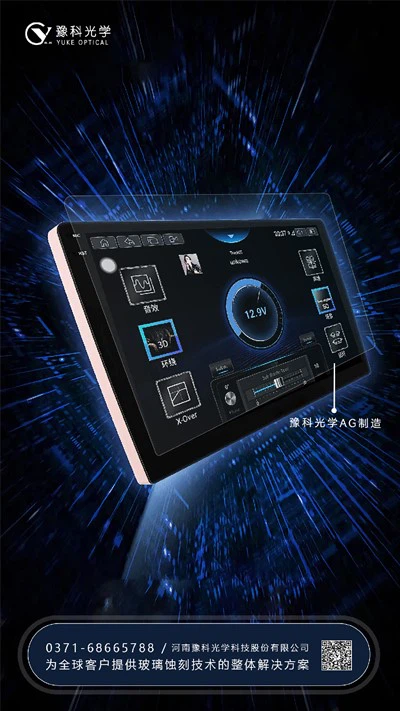
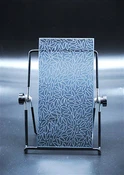
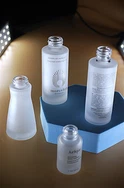
AG glass, is known as anti-glare glass, which is made by a special chemical process, can make the original glass reflective surface into a matte diffuse reflective surface to prevent glare. Anti-glare glass by chemical etching or spraying, the reflective surface of the original glass is changed to a diffused surface, which changes the roughness of the surface of the glass, thereby producing a matte effect on the surface. When the outside light is reflected , it will form a diffuse reflection, which will reduce the reflection of light, and achieve the purpose of not glare, so that the viewer can experience better sensory vision.



I. Pre-face
Etching chemical react with glass surface rapidly in practical
production, to create a homogeneous satin effect as there is a
consistent repetition of the starting attack points resulting in a
uniform repartition of the pyramids and an optimal frosted effect.
After reaction, rinse with water, 100% glass is left, and glass
surface has been altered and the frosted effect won’t be lost over
time.
II. Specification
Physical state: Solid
Form: Powder
Color: White
Package(standard): 25kg/bag
Environment protection : Conform to SGS
III. Operation Procedure
Pre-treament --Frosting--Dripping-- Rinsing-- Spray Cleaning
IV. Contact
www.chinayuke.com
www.glassfrostingpowder.com
ykfrostingpowder@chinayuke.com.cn
ykfrostingpowder@chinayuke.com
Tel:0086-371-69382288
Advantages of AG Glass
Reducing screen reflection
The example shows that the display screen with single-sided anti-glare glass is far superior to the glossy glass screen in reducing screen reflection and environmental illusion, improving screen display, improving picture quality and visual comfort.
Anti-glare effect
Double-sided anti-glare glass not only has anti-glare effect on both surfaces of glass, the key is that any single-sided and overall anti-glare parameters meet certain performance indicators.
Eliminates ghosting
We analyze the mechanism and method of glass reflection and phantom formation, and double-block the path of light glare on and off the screen.
Improve visual comfort
The screen can be seen from a wider viewing angle, and the visual comfort is higher. Its performance is especially suitable for bright environments.
Why Choose Us
High quality
Our products are manufactured or executed to a very high standard, using the finest materials and manufacturing processes.
Advanced equipment
A machine, tool or instrument designed with advanced technology and functionality to perform highly specific tasks with greater precision, efficiency and reliability.
Professional team
Our professional team collaborates and communicates effectively with each other, and is dedicated to delivering high quality results. We are capable of handling complex challenges and projects that require our specialized expertise and experience.
Quality control
We have built a professional quality control team to accurately inspect every raw material and every production process.
Customized services
We understand that each customer has unique manufacturing needs. That's why we offer customization options to cater to your specific requirements.
24H online service
We try and respond to all concerns within 24 hours and our teams are always at your disposal in case of any emergencies.
Outdoor display or display applications under strong light. Such as advertising screens, ATM cash machines, POS cash registers, medical B-displays, e-book readers, subway ticket machines, and so on. Place a piece of glass under the fluorescent light and observe the tube from the front of the glass. If the light source of the lamp is dispersed, it is the AG treatment surface, and if the light source of the lamp is clearly visible, it is a non-AG surface. After the glass is optically coated, it reduces its reflectivity and increases the transmittance. The maximum value can increase its transmittance to over 99% and its reflectivity to less than 1%. By increasing the transmittance of the glass, the content of the display is more clearly presented, allowing the viewer to enjoy a more comfortable and clear sensory vision. Application areas glass greenhouse,high-definition displays, photo frames, mobile phones and cameras of various instruments, front and rear windshields, solar photovoltaic industry, etc.

The Difference Between AG Glass and AR Glass
Many people can’t tell the difference between AG glass and AR glass and what’s the difference of the function between them. AG glass, the full name is anti-glare glass, also call as non-glare glass, which used to reduce strong light reflections or direct fire. AR glass, the full name is anti-reflection glass, also known as low-reflective glass. It mainly use to de-reflection, increase transmission. Therefore, in terms of optical parameters, AR glass has more functions to increase the light transmission than AG glass. AG glass production principle: After “coarse” the glass surface, the glass reflective surface (flat mirror) becomes a non-reflective matte surface (a rough surface with uneven bumps). Comparing it with ordinary glass with a lower reflectivity ratio, the reflectivity of light is reduced from 8% to less than 1%, using technology to create clear and transparent visual effects, so that the viewer can experience better sensory vision. AR glass production principle with the using of the world’s most advanced magnetically controlled sputter coating technology in the ordinary reinforced glass surface coated with a layer of anti-reflective film, effectively reduce the reflection of the glass itself, increase the glass penetration rate, so that the original through the glass more vivid color, more realistic. If the use of the product environment has strong light or direct light, for example, outdoor, it is recommended to use AG glass, because AG processing makes the glass reflective surface into a matte diffuse surface. It can make the reflection effect blurred, prevent glare outside also make the reflectivity drop, and reduce light and shadow. In some special environment, such as hospitals, food processing, sun exposure, chemical plants, military, navigation and other fields, it requires the matte surface of the glass cover must not occur shedding cases. Such as plasma TV, PTV back-drop TV, DLP TV splicing wall, touch screen, TV splicing wall, flat-screen TV, back-drop TV, LCD industrial instrumentation, mobile phones and advanced video frames and other fields. HD display environment, such as the product usage requires a high degree of clarity, rich colors, clear levels, eye-catching; for example, watching TV want to see HD 4K, picture quality should be clear, color should be rich in color dynamics, reduce color loss or color difference…, the visible places such as museum display cabinets, displays, optical instruments in the field of telescopes, digital cameras, medical equipment, machine vision including image processing, optical imaging, sensors, analog and digital video technology, computer technology, etc. AG glass manufacturing process requirements very high and strict, there are only few companies in China can proceed AG glass production, especially glass with acid etching technology is quite less. Presently, in large-size AG glass manufacturers, only Saida Glass can reach 108 inches of AG glass, mainly because it is the use of self-developed “horizontal acid etching process”, can ensure the uniformity of AG glass surface, no water shadow, product quality is higher.
AG anti-glare glass products are made through a special chemical process, which is characterized by changing the reflective surface of the original glass into a matte diffuse reflective surface. It can blur the effect of reflection, prevent glare and reduce the degree of reflection, reduce light and shadow, and the surface of anti-glare products has strong anti-corrosion and anti-scratch performance.Combined with the video imaging screen, it can form a transparent anti-glare and anti-reflection screen, which solves the problems of reflection and glare caused by electronic video screens and video screens under ambient light sources, and improves the image quality. This effect does not change at large viewing angles. When the external light is reflected, it will form diffuse reflection, thereby reducing the reflection of light, achieving the purpose of not dazzling, so that viewers can experience better sensory vision. The lower the glossiness, the better the diffuse effect of its surface, and the less affected by external glare. AG glass has single-sided and double-sided, and the AG-treated side must be on the top when used. Outdoor digital signage displays or displays under strong light are mostly used. Such as advertising displays, ATM cash machines, POS cash registers, medical B-ultrasound displays, e-book readers, gas station displays, subway ticket inspection machines, etc. Simple identification method, put a piece of glass under a fluorescent lamp, and observe the lamp tube from the front of the glass. If the light source of the lamp tube is dispersed, it is an AG-treated surface, and if the light source of the lamp tube is clearly visible, it is a non-AG surface. This is the most direct way to tell from the visual effect.

Anti-glare glass, is a special processing of the glass surface, normally the glass is etched in specific chemical liquid, so it is also called etched glass. It is characterized by making the reflective surface of the original glass become matte surface without reflection. The principle is to double or single side of high quality glass through special processing. Compared with ordinary glass, it has a lower reflection ratio, and the reflectivity of light is reduced from 8% to less than 1%, creating a clear and transparent visual effect with technology, so that viewers can experience a better sensory vision. According to the transmittance, it can be divided into: single-sided ordinary grade, double-sided ordinary grade, single-sided high transmittance grade, double-sided high transmittance grade. According to the use is divided into: single-side screen level, double-side screen level, touch high screen level, ordinary instrument level, precision instrument level, engineering level, etc. Despite being around for a long time, AG (Anti Glare) glass coating is now gaining traction on smartphones. As opposed to wide color displays and other emerging display types, AG Glass coating gives your eyes a soothing viewing experience. The anti glare glass coating (often known as matte) is a special layer fused into the equipment's display that reduces light reflection. In simple words, the AG layer is designed to prevent maximum reflection from the light falling on the screen, consequently improving visual readability. Therefore, you can use devices with this coating in brighter environments without being bothered by screen glare spoiling your viewing experience. As of now, this technology is widely used in televisions to provide vibrant colors and better viewing angles.
Observing your own reflection on the screen is the easiest technique to spot an AG Glass coating on your smartphone. If you can view your entire reflection clearly on the device's screen like a mirror, it doesn't have an anti glare coating. Conversely, if your reflection is blurry or hazy, like a matte texture, your phone's screen has an AG glass coating. Similarly, you can bring your smartphone under a bright light to check for an AG coating. If the light falling on your device's screen disperses evenly without causing glare, it has an AG (Anti Glare) coating. In case your smartphone doesn't have an AG glass coating, you can experience the same by installing matte screen protectors to protect your eyes from the shining glare of the screen. It provides better screen viewability, making it easier to see sharp elements, especially in bright light. The anti glare coating reduces the unnecessary eye strain from prolonged exposure to the screen's reflected light (glare). Panels with AG coating are comparatively easier to clean as the dust and fingerprint don't get stuck directly on the screen. You can clean such screens easily using a microfiber cloth. Unlike glossy screens, ordinary scratches and lines are barely visible on the AG glass-coated screens, making them more durable in the long run.
AG Glass Processing Process
AG doesn't just reduce glare; it also minimizes eye strain, letting you work longer without discomfort. It’s like sunglasses for your screen but without the fashion statement. Common AG processes are mainly divided into: chemical etching AG, spray AG, coating AG, sandblast AG, and film AG. The following mainly introduces coating AG, sprayed AG, and chemical etching AG process. AG coating (anti -glare coating) is a atomized coating technology. The AG anti -glare film is a type of polarizing tablet. By performing microfinance on the surface of the polarizer, it is necessary to prevent the light from entering the eyes, thereby effectively reducing glare and reflection. Originally applied to a car rearview mirror. The processing of coating AG determines that its hardness value is difficult to change. The coating AG scratches after a period of use, and the handwriting touch is not far from the tactile touch on the paper. Therefore, it is limited to its application range and basically only applied to the rear -view mirror. A small amount is used on TV screen glass and navigation instruments glass. As the requirements of the AG glass are getting higher and higher, the coating AG gradually fades out of the market. Spraying AG technology is to form a layer of uniformly dispersed nano -grade silicon particles suspension on the glass surface by spraying equipment which is attached to the glass surface on the glass surface after heat treatment . Its advantage is that this processing process is convenient and fast, and the production efficiency is high. It can easily process high -quality products with different luster and mist. The disadvantage is that the granularity of the spray AG is still a bit unsatisfactory. Due to the environment and use factors, the AG layer peeling and the friction resistance of the AG surface decline.Chemical etching AG, with hydrofluoric acid, fuses the silicon oxygen on the glass surface layer, and obtains a glossy surface or no glossy surface depending on the degree of solubility of residual salt. It is characterized by turning the original glass reflective surface into a matte manner. It can cause the reflector to blur, prevent the reflectiveness beyond the glare, and reduce the light and shadow. Anti -glare products have strong anti -corrosion and injury. Solve the reflection and glare of the electronic screen and image screen in the ambient light. The etching AG is a chemical etching. After the AG is treated, it is still the glass surface. So the product life is equivalent to the general reinforced glass. The uniform granules cannot be achieved by the first two processes.
With the emergence of AG glass cover, people gradually recognise that it has stronger anti-glare, good touch and corrosion resistance and other advantages, and will play an important role in the application of precision instruments, military equipment, automobiles and other fields. AG technology conforms to this development trend and medical electronic instruments combined with each other to form a new application of glass cover, which can effectively break through the limitations of ordinary glass in the field of medical and health care. It has been widely used. As we all know, the medical industry has strict requirements for the production of medical electronic products. In special environments such as surgery and testing, the focused light needs to be brighter, etc., and the content on the screen needs to be clearly visible. AG coated glass meets this requirement by increasing the transmittance rate to aid in imaging.This ensures that doctors can clearly see the image behind the screen from any angle, even under bright light. AG etched glass belongs to chemical etching. It will not be sterilised with alcohol following medical use like ordinary spray glass, which may delaminate after a while. In contrast, AG etched glass will never delaminate. It meets the anti-corrosion standards and can be adapted for frequent sterilisation before and after medical procedures. And the special coating used on this glass is easier to clean and sterilise, which is critical in preventing the spread of germs and infections. AG glass is also extremely durable, a must-have quality for medical equipment. Medical equipment and instruments have a long lifespan and are often subjected to a great deal of wear and tear, which can cause ordinary glass to crack or chip. However, AG glass is able to withstand these types of impacts, which reduces equipment failure and repair costs.

FAQ
We're well-known as one of the leading ag glass manufacturers and suppliers in China for 25 years. Welcome to buy high quality ag glass made in China here from our factory. For price consultation, contact us.
anti glare glass for routers, anti glare glass for optical waveguides, anti glare glass for optical fibers