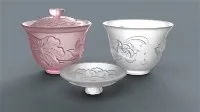
In order to produce acid etched glass, a piece of glass is etched by hydrofluoric acid gas, or by hydrofluoric acid. In its appearance, the gaseous acid resembles ground glass; the liquid acid produces clear, precise etching. Therefore, etching glass consists of two distinct branches.
First, when the gas is used, you create a dull image on a transparent surface and second, a clear image is produced on the part of the surface that has previously been dulled or ground by using the liquid acid.
Next, we gently clean and warm the glass plate, waiting to be etched until it is hot enough to melt the wax. We then cover the glass's surface with an equal layer of white wax, by rubbing the glass's wax.
When the wax is cold, a graver is used to cut a wax design. We then obtain a shallow trough, about the size a little smaller than a plate. A small amount of finely powdered fluorspar is placed inside the channel. It is essential the powder is weighed and then sifted gently over the bottom of the trough.
Going by weight, for every two parts of fluorspar, we add three parts of vitriol oil.
Using a wooden stick, stir the mixture quickly, and place the trough in a warm place or on the hob. Vapour will soon start to rise.
Now remove the trough and cover it, wax side down with the graved and waxed plate. Very quickly, the acid will have etched into the bare portions of the glass plate. When the glass plate is sufficiently etched, melt the wax to remove it.
For clear etching, prepare the liquid acid by placing two parts of fluorspar and three parts of sulphuric acid in a heavy vessel. The tube of which should dip into a leaden bottle half-filled with water.