Hey there! As a supplier of 3D laser engraving equipment, I often get asked about various technical aspects of our products. One question that pops up quite frequently is, "What is the focal length in 3D laser engraving?" Well, let's dive right into it and break it down in a way that's easy to understand.
First off, what exactly is focal length? In simple terms, the focal length of a lens in a 3D laser engraving system is the distance between the lens and the point where the laser beam converges to its smallest possible spot. This point is known as the focal point. Think of it like a magnifying glass in sunlight. When you hold the magnifying glass at just the right distance from a piece of paper, the sunlight focuses into a tiny, intense spot that can burn the paper. In 3D laser engraving, the laser beam acts like that focused sunlight, and the focal length determines where that intense spot of energy will be.
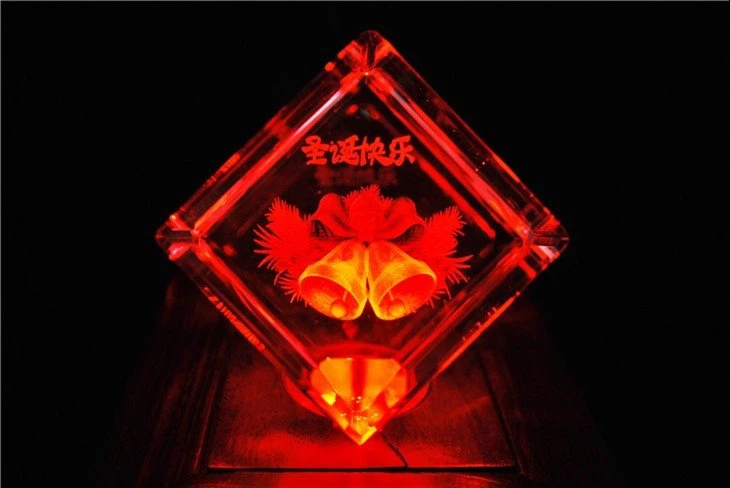
Now, why is the focal length so important in 3D laser engraving? Well, it has a huge impact on the quality and precision of the engraving. A shorter focal length means the laser beam converges more quickly, resulting in a smaller focal spot. This is great for detailed and high - precision engraving. For example, if you're working on a 3D Laser Engraving Crystal Craft where you need to create fine details like the delicate features of a portrait or the intricate patterns on a small ornament, a shorter focal length lens is your best bet.
On the other hand, a longer focal length causes the laser beam to converge more gradually, creating a larger focal spot. This is useful when you need to cover a larger area quickly. Let's say you're doing a 3D Laser Engraving Glass project where you want to engrave a big logo or a large design on a glass surface. A longer focal length will allow you to cover more ground in less time, although the level of detail might not be as high as with a shorter focal length.
But it's not just about the size of the focal spot. The focal length also affects the depth of field. The depth of field is the range of distances in front of and behind the focal point where the laser beam remains relatively focused and can still produce a good - quality engraving. A shorter focal length typically has a shallower depth of field. This means that if your workpiece has some unevenness or if you're engraving at different depths within the material, you might need to adjust the position of the workpiece more carefully to keep the laser in focus.
Conversely, a longer focal length usually has a deeper depth of field. This gives you more leeway when it comes to working on uneven surfaces or engraving at multiple depths. For instance, when you're doing 3D Laser Etching Glass and the glass has a slightly curved surface, a longer focal length can help you maintain a decent level of focus across the entire engraving area.
Another factor to consider is the working distance. The working distance is the distance between the lens and the surface of the workpiece. A shorter focal length generally results in a shorter working distance. This can be a limitation in some cases, especially if you're working with large or bulky workpieces. You might not have enough space to position the lens close enough to the surface without the engraving machine interfering with the workpiece.
A longer focal length, however, gives you a greater working distance. This is beneficial when you're dealing with large or irregularly shaped objects. You can position the lens further away from the workpiece, allowing for more flexibility in terms of workpiece size and shape.
When choosing the right focal length for your 3D laser engraving project, you need to take into account several factors. First, think about the level of detail you need. If you're aiming for highly detailed work, a shorter focal length is likely the way to go. But if you're more concerned with covering a large area quickly, a longer focal length might be better.
You also need to consider the type of material you're working with. Different materials have different optical properties, and these can affect how the laser beam interacts with them. For example, glass and crystal are transparent materials, and the way the laser beam penetrates and engraves them can be influenced by the focal length.
In addition, the size and shape of the workpiece matter. As mentioned earlier, if you have a large or irregularly shaped workpiece, a longer focal length with its greater working distance and deeper depth of field might be more suitable.
At our company, we offer a range of 3D laser engraving systems with different focal length options to meet the diverse needs of our customers. Whether you're a small - scale crafter looking to create unique 3D Laser Engraving Crystal Craft pieces or a large - scale manufacturer working on 3D Laser Engraving Glass products, we've got you covered.
We understand that choosing the right focal length can be a bit confusing, especially if you're new to 3D laser engraving. That's why our team of experts is always here to help. We can provide you with detailed advice based on your specific project requirements, ensuring that you get the best results possible.
If you're interested in learning more about our 3D laser engraving systems or have any questions about focal length or other technical aspects, don't hesitate to reach out. We're always happy to have a chat and discuss how we can help you take your 3D laser engraving projects to the next level. Whether you're just starting out or looking to upgrade your existing equipment, we're here to support you every step of the way.

So, if you're in the market for high - quality 3D laser engraving equipment and want to make an informed decision about focal length and other features, get in touch with us. We're eager to work with you and help you achieve your engraving goals.
References
- Optics for Dummies, Wiley Publishing
- Laser Engraving: Principles and Practices, Industrial Laser Publications