As a reputable supplier of chemical etching solutions for glass, I understand the critical importance of accurately measuring the depth of chemical etching. Whether you're in the glass manufacturing industry, creating decorative glass items, or involved in scientific research, precise depth measurement is essential for achieving the desired results. In this blog post, I'll share some effective methods for measuring the depth of chemical etching for glass and discuss why it matters.
Why Measuring Etching Depth is Important
Before delving into the measurement methods, let's first understand why measuring the depth of chemical etching for glass is crucial. The etching depth directly affects the appearance, functionality, and quality of the etched glass. For decorative applications, such as glassware, mirrors, or architectural glass, the etching depth determines the level of transparency, opacity, and the overall aesthetic appeal. A consistent and well-controlled etching depth ensures a uniform and professional-looking finish.
In industrial and scientific applications, the etching depth can impact the performance of the glass. For example, in microfluidic devices or optical components, precise etching depth is necessary to control the flow of fluids or the transmission of light. Incorrect etching depth can lead to functional failures or inaccurate results.
Moreover, measuring the etching depth allows for quality control during the manufacturing process. By monitoring and adjusting the etching parameters based on the measured depth, manufacturers can ensure that each glass product meets the specified requirements. This helps to reduce waste, improve productivity, and enhance customer satisfaction.
Methods for Measuring Etching Depth
Profilometry
Profilometry is a widely used method for measuring the surface profile and etching depth of glass. It involves scanning the etched surface with a stylus or a non-contact sensor to obtain a three-dimensional profile of the surface. The stylus profilometer uses a fine-tipped stylus that moves across the surface, measuring the vertical displacement as it encounters the etched features. Non-contact profilometers, such as optical profilometers, use light interference or confocal microscopy to measure the surface topography without physical contact.
One of the advantages of profilometry is its high accuracy and resolution. It can provide detailed information about the surface roughness, step height, and etching depth. However, profilometry requires specialized equipment and skilled operators, and it can be time-consuming and expensive.
Ellipsometry
Ellipsometry is an optical technique that measures the change in the polarization state of light reflected from the etched surface. By analyzing the ellipsometric parameters, such as the ellipsometric angles and the phase shift, the thickness and refractive index of the etched layer can be determined. Ellipsometry is a non-destructive and non-contact method that can provide accurate measurements of thin films and surface layers.
Ellipsometry is particularly useful for measuring the etching depth of thin films or coatings on glass. It can also be used to study the chemical composition and structure of the etched surface. However, ellipsometry requires a clean and flat surface, and it may not be suitable for measuring rough or irregularly etched surfaces.
Scanning Electron Microscopy (SEM)
Scanning Electron Microscopy (SEM) is a powerful imaging technique that uses a focused beam of electrons to scan the surface of the etched glass. It provides high-resolution images of the surface morphology and can be used to measure the etching depth by analyzing the cross-sectional view of the etched features. SEM can also provide information about the surface composition and the crystal structure of the glass.
SEM is a valuable tool for studying the etching mechanism and the effects of different etching parameters on the surface morphology. However, SEM requires a vacuum environment and sample preparation, such as coating the sample with a conductive material to prevent charging. It is also a relatively expensive and time-consuming method.


Atomic Force Microscopy (AFM)
Atomic Force Microscopy (AFM) is a high-resolution imaging technique that uses a sharp probe to scan the surface of the etched glass. The probe interacts with the surface atoms through the van der Waals forces, and the resulting deflection of the probe is measured to obtain a three-dimensional image of the surface. AFM can provide detailed information about the surface topography, roughness, and etching depth at the nanoscale.
AFM is a non-destructive and non-contact method that can be used to measure the etching depth of both flat and curved surfaces. It is particularly useful for studying the surface properties of thin films and nanostructures. However, AFM has a limited scanning area and can be affected by environmental factors, such as vibrations and temperature changes.
Factors Affecting Etching Depth
The depth of chemical etching for glass is influenced by several factors, including the etching solution, the etching time, the temperature, and the surface properties of the glass. Understanding these factors is essential for controlling the etching process and achieving the desired etching depth.
Etching Solution
The composition and concentration of the etching solution play a crucial role in determining the etching rate and depth. Different etching solutions have different chemical properties and reactivity towards glass. For example, hydrofluoric acid (HF) is a commonly used etching solution for glass because it can react with the silica in the glass to form soluble fluoride compounds. The concentration of HF in the etching solution affects the etching rate, with higher concentrations generally resulting in faster etching.
Other additives, such as surfactants or inhibitors, can also be added to the etching solution to modify the etching behavior. Surfactants can reduce the surface tension of the solution, improving the wetting of the glass surface and enhancing the etching uniformity. Inhibitors can slow down the etching rate or prevent over-etching.
Etching Time
The etching time is directly related to the etching depth. Longer etching times generally result in deeper etching. However, the relationship between etching time and depth is not always linear, as the etching rate may change over time due to factors such as the depletion of the etching solution or the formation of a passivation layer on the glass surface. Therefore, it is important to monitor the etching process and adjust the etching time based on the desired depth.
Temperature
The temperature of the etching solution affects the chemical reaction rate and the diffusion of the etching species. Higher temperatures generally increase the etching rate, but they can also lead to increased surface roughness and non-uniform etching. Therefore, it is necessary to optimize the temperature to achieve the desired etching depth and surface quality.
Surface Properties of Glass
The surface properties of the glass, such as the composition, structure, and roughness, can also affect the etching behavior. Different types of glass have different chemical compositions and reactivity towards the etching solution. For example, borosilicate glass is more resistant to etching than soda-lime glass. The surface roughness of the glass can also influence the etching rate, as rough surfaces provide more surface area for the etching reaction to occur.
Using High-Quality Etching Materials
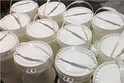
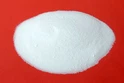
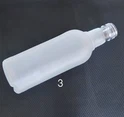
To achieve the best results in chemical etching for glass, it is important to use high-quality etching materials. At our company, we offer a range of Etching Powder for Glass that are specifically formulated for different types of glass and etching applications. Our YK Glass Frosting Powder For Glass Bottles is designed to create a smooth and uniform frosted finish on glass bottles, while our Ordinary Glass Etching Powder is suitable for general glass etching applications.
Our etching powders are made from high-purity chemicals and are carefully formulated to ensure consistent etching performance. They are easy to use and can be customized to meet the specific requirements of our customers. By using our high-quality etching materials, you can achieve precise and reproducible etching results, with better control over the etching depth and surface quality.
Conclusion
Measuring the depth of chemical etching for glass is essential for achieving the desired appearance, functionality, and quality of the etched glass. Profilometry, ellipsometry, SEM, and AFM are some of the commonly used methods for measuring the etching depth. Each method has its own advantages and limitations, and the choice of method depends on the specific requirements of the application.
Factors such as the etching solution, etching time, temperature, and surface properties of the glass can affect the etching depth. By understanding these factors and using high-quality etching materials, manufacturers can control the etching process and achieve the desired results.
If you are interested in purchasing high-quality etching materials for your glass etching applications, please feel free to contact us. Our team of experts is ready to provide you with technical support and advice to help you achieve the best results.
References
- Bhushan, B. (2001). Handbook of Micro/Nanotribology. CRC Press.
- Sze, S. M. (1985). VLSI Technology. McGraw-Hill.
- Thompson, M. O., & Meyer, T. J. (2004). Chemical Sensors and Biosensors. Analytical Chemistry, 76(23), 664A-671A.